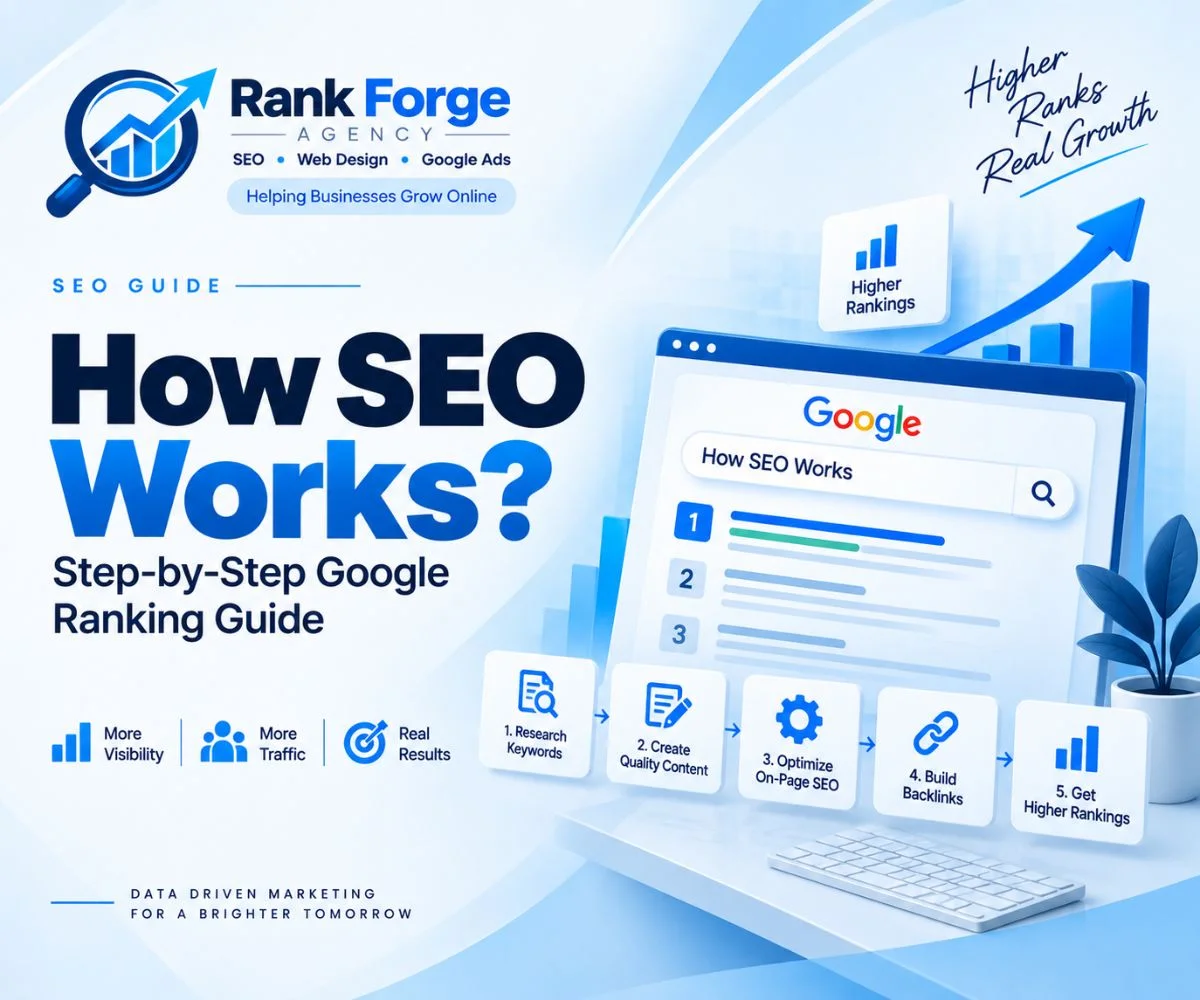
How SEO works breaks down into one pipeline with three stages. Google crawls your pages with software, files them in its index, then ranks them for every search. SEO is the work you do to perform better at each stage.
Table of Contents
- How SEO Works in 30 Seconds
- Step 1: Crawling
- Step 2: Indexing
- Step 3: Ranking
- What Determines Rankings
- SEO in Digital Marketing
- How SEO Is Done on a Website
- How Long Does SEO Take
- How SEO Works FAQ
- Final Takeaways
How SEO Works in 30 Seconds
Google runs on a three-stage pipeline. First, software called crawlers reads your pages. Then Google files those pages in its search index. Finally, an algorithm scores every indexed page against every other page for a given search, and the highest-scoring pages become the results.
That pipeline is the whole system. SEO is the work you do to improve how well your pages perform at each stage, so Google reads them, files them, and ranks them above your competitors. If you are new to SEO, start with our beginner guide first, then come back for the mechanics.
Here is the process broken down step by step.
Step 1: Crawling
Crawling is discovery. Google sends automated software called Googlebot to follow links across the web and download whatever it finds there.
Googlebot finds pages through three routes: internal links from pages it already knows, links from other websites, and the URLs you submit through your XML sitemap.
A page only reaches this stage if Google can reach it without restrictions. A robots.txt rule that blocks the page, a noindex directive, or a redirect loop all stop crawling cold. So does a site that runs too slowly, because Googlebot budgets only so much time per site on each visit.
Step 2: Indexing
Indexing is filing. After Googlebot downloads a page, an algorithm decides what the page is about and stores that understanding in the Google index, which is essentially Google's library of every page it considered worth keeping.
To index well, your page needs enough clear content for Google to understand the topic. Thin pages, weak headings, missing title tags, and duplicate content give the algorithm little to work with and can keep a page out of the index entirely.
You can verify what Google sees. Search in Google for site:yourdomain.com to see which pages are indexed. Anything missing from those results has not made it into the index yet.
Step 3: Ranking
Ranking is scoring. When someone types a query, Google pulls the relevant pages from its index and orders them using hundreds of signals at once.
Those signals include how closely the page matches the intent behind the words, how authoritative the website looks, how well the page performs technically, how fresh the content is, and how many high-quality sites link to it.
The page that wins is rarely the one optimized for a single factor. It is the page that scores well across relevance, authority, and user experience at the same time.
What Determines Rankings
The ranking system weighs three broad buckets of signals.
Relevance decides whether your page answers the question behind the search. Your title tag, headings, and content all tell Google what you cover, and any mismatch between the words people use and the words in your content hurts you here.
Authority measures trust. Links from other websites are the strongest signal, and links from respected, topically related sites count for far more than links from directories or spam networks. Brand searches and mentions matter to a lesser degree.
Experience includes page speed, mobile friendliness, Core Web Vitals, and whether visitors stay or bounce. Google has repeatedly shown that fast, usable pages outrank slow, clunky ones when everything else is equal.
The overlap test: write to match intent, earn links from trusted sites, and keep the page fast and clean. That covers all three buckets at once.
How SEO Works in Digital Marketing
SEO is the organic channel inside digital marketing. While paid channels like Google Ads buy traffic per click, SEO earns visibility through these ranking signals, and that earned traffic keeps arriving month after month without a per-click cost.
The two channels work differently. Paid search stops the moment you stop paying. Organic search keeps delivering on the rankings you already built, and every new page you rank adds to that flow. That is why most serious businesses run SEO alongside paid ads, using each for what it does best.
How SEO Is Done on a Website
Seen from the inside, SEO is a set of tasks that feed these three stages.
You improve crawling with a clean site structure, a correct sitemap, and a robots.txt that points Googlebot the right way. You improve indexing with unique, well-structured content and correct canonical tags. You improve ranking with keyword-focused titles and headings, fast pages, secure HTTPS, internal links between related content, and links pointing at you from other sites.
Everything maps back to the same pipeline. There is no separate trick for how SEO optimization works beyond making each stage easier for Google to complete.
How Long Does SEO Take to Work
Realistic timelines depend on where you start. A new website usually sees meaningful movement between 3 and 6 months, while a site with an existing content base and history can improve faster.
Two things consistently decide the timeline. Competition in your niche sets the ceiling, and the volume and quality of content and links you build sets the speed. A page targeting a local, low-competition keyword can rank in weeks. A page in a crowded national market can take a year.
Want the numbers behind these timelines? Google's own How Search Works page documents the ranking system and the signals it uses.
How SEO Works FAQ
| Question | Short Answer |
|---|---|
| How does SEO work step by step? | Crawling, then indexing, then ranking your page against every other page for the query. |
| How does SEO work in digital marketing? | SEO earns organic, non-paid traffic through ranking signals instead of buying clicks. |
| How does SEO work for a website? | You feed the pipeline: clean structure for crawlers, clear content for indexing, and links and speed for ranking. |
| What makes Google rank one page over another? | The page that best combines relevance, authority, and user experience for the search. |
| Does SEO actually work? | Yes, when the keyword is realistic and the content and links are built consistently over months. |
| How long does SEO take? | Usually 3 to 6 months for a new site to see meaningful movement. |
Final Takeaways + Next Step
SEO works on one clear pipeline: Google crawls, indexes, and ranks your pages, and SEO is the work you do to perform better at each stage. Nail crawling with structure, indexing with clear content, and ranking with relevance, authority, and speed, and the system rewards you with organic traffic.
Next step: Run a free SEO audit and see exactly which of these three stages is holding your site back, with fixes ranked by effort.
Get Free SEO AuditRelated Guides (Hub & Spoke)
This guide lives inside the SEO Fundamentals cluster, alongside the complete "What Is SEO?" guide. More pillar and supporting guides for keyword research, on-page SEO, technical SEO, link building, local SEO, WordPress, and AI search are being published across our blog. If you are planning your budget today, check how much SEO costs in Pakistan to see real pricing and packages.

Written by Muhammad Mohsin
Founder & SEO Strategist at Rank Forge Agency. 9 min read · Updated September 2026.